|
|
Post by lagatta on May 7, 2010 19:24:27 GMT
Lovely! Funny how foods can be of similar components, yet strikingly different in each country. Filipinos I know would eat all those foods for breakfast, but they usually fry eggs whole and the pork preparation is different as well. What is the beverage - iced coffee or a fizzy drink?
|
|
|
|
Post by hwinpp on May 8, 2010 2:53:47 GMT
Yes, it is iced coffee.
What I find strange is that people eat so many duck eggs here. If you just order eggs, they'll automatically give you duck eggs. They're cheaper too (which is the reason) but why? Do ducks produce more eggs or are they less work intensive or what?
|
|
|
|
Post by Don Cuevas on May 9, 2010 15:35:07 GMT
This morning, we had what I call a "Desayuno Pablo", named after our friend Pablo Span, co-owner and host of the Hotel Rancho San Cayetano, near Zitácuaro, México.
It's a breakfast with, I think, Middle European roots. It consists of cold raw vegetables, such as cucumbers, radish and onions, served with good bread and some cream cheese. I added some lengths of sweet red pepper and an avocado half for each of us. It was perfect for the day as we'll have a mighty Pho later today.
|
|
|
|
Post by Don Cuevas on May 12, 2010 11:46:56 GMT
May 12, 2010
Breakfast is Baked Macaroni and Cheddar Cheese, and a crisp, sweet and sour, no oil/no mayo Coleslaw. (Cabbage, carrots, sweet red peppers, onions, garlic, parsley, white wine vinegar, sugar, mustard powder, celery seeds (very little, as it has run out.)
|
|
|
|
Post by bixaorellana on May 12, 2010 16:52:19 GMT
What I find strange is that people eat so many duck eggs here. If you just order eggs, they'll automatically give you duck eggs. They're cheaper too (which is the reason) but why? Do ducks produce more eggs or are they less work intensive or what? Don't take my word for this, but I believe ducks are more able to live on scraps than chickens are, thus easier to keep. It could also allow for lots of small-scale suppliers of duck eggs. Have you asked around? This is an interesting question. Given a choice, I'd go with duck eggs every time. |
|
|
|
Post by hwinpp on May 13, 2010 7:59:28 GMT
Yes, I have asked around but all I get is 'they're cheaper'...  |
|
|
|
Post by bixaorellana on May 13, 2010 16:45:34 GMT
Because I live to Google, I looked it up. My guesses seem to have been pretty accurate: Advantages of ducks compared with chickens:
* Ducks are tougher than chickens; they require less attention than chickens and are less likely to be sick than chickens.
* Ducks are larger than chickens, so if they are reared for meat there will be more to sell. Duck eggs are also larger than chicken eggs.
* Ducks do not necessarily need supplementary grain and maize. Chickens normally do need supplementary high quality feed. Ducks eat more vegetablesource: www.mixph.com/2009/02/duck-raising-in-the-tropics.htmlDucks happily live outside in all weathers; their housing is cheaper than a chicken house; they can be easily confined in their breeding pens; and they have a lot of sense. Show ducks where to go once or twice, and they will remember what you want them to do next time.source: www.smallholder.co.uk/news/1484119.how_ducks_will_reward_you_but_dont_be_under_any_illusions_if_you_want_to_keep_these_birds_says_chris_ashton/ |
|
|
|
Post by Don Cuevas on May 16, 2010 11:46:25 GMT
Yesterday, we walked to a friend's house and found her, as we had expected, making tortillas in her tejabán, or outdoor kitchen. I just finished uploading a series of photos and a video of this. There is a warm, tranquil atmosphere in the tejabán, accompanied by the soft sounds of the wood fire and the birds' songs outdide. We were given delicious, hot tortillas, then queso fresco and frijoles to have with them. It was a wonderful late breakfast. picasaweb.google.com/doncuevas/ElTejabanDeMaria?feat=directlink |
|
|
|
Post by fumobici on May 16, 2010 17:44:19 GMT
Beautiful and interesting series of photos. I'd eat that any time of the day.
|
|
|
|
Post by spindrift on May 16, 2010 18:03:15 GMT
Don C...I really enjoyed your pictures and video. At the end of the video is Maria wrapping and sealing the tortillas in order to sell them?
|
|
|
|
Post by Don Cuevas on May 17, 2010 13:49:22 GMT
Don C...I really enjoyed your pictures and video. At the end of the video is Maria wrapping and sealing the tortillas in order to sell them? Thank you, Spindrift. No; they are just for her family's use. I don't note anywhere in the video where she was wrapping and sealing them. The finished tortillas go into a small woven basket, whose local name I forget. The second photo shows her unwrapping her birthday present from us. I hope to photograph more tejabanes in the not too distant future. Our landlady's, just across the way, is a lean-to shed in the patio. It appears to me that great pleasure is taken to prepare breakfast there. I have to duck my head to enter. It's very cozy and a bit smoky. |
|
|
|
Post by Don Cuevas on May 17, 2010 13:55:59 GMT
This morning's breakfast was stone ground yellow corn grits, eggs from our neighbor's hens, a slice of cheddar on the grits, and agua fresca de guanábana. 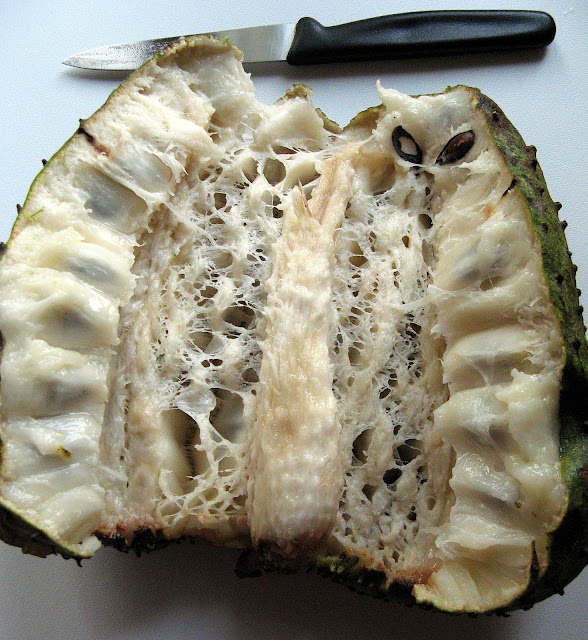 Guanábana anatomy. |
|
|
|
Post by Deleted on May 17, 2010 14:36:37 GMT
What a gorgeous photo of a very interesting,unbeknownstto me,tasted fruit...I encountered some strange,interesting fruit in Chinatown. Always love tasting new and exotic fruit.(Will post pics of soon).
I have been enjoying each morning eating a fresh croissant from a French baker here and a large cup of strong,strong coffee served in the French style of a bowl looking thing,(forget what it's called...). The cafe is right next to the library where I use the computer while here.
|
|
|
|
Post by lagatta on May 17, 2010 15:36:04 GMT
It is simply called a bol, casimira. www.pillivuyt.fr/pillivuyt-catalogue-grand-public-produit.php?SCID=21&DEB=8&ID=205 Mine are these white French porcelain bowls, and yes, in pure cheapskate fashion, I've found them at church bazaars and garage sales. I don't use them for coffee much as I drink espresso and that would be a hell of a lot of espresso - they are there for guests' café au lait, but I also use them for other things, as they are so classically pretty. |
|
|
|
Post by Deleted on May 17, 2010 15:46:23 GMT
Thanks Lagatta, I was actually counting on you to tell me what they were.   I had a couple of them years ago,My husband really likes them for dipping bread into. This very same restaurant is run by a Parisian fellow,I have been going there for years. They serve an excellent breakfast. But,my favorite meal there is lunch,as one can get a really good steak tartare,something not real prevalent around here,and it is a well loved dish by enough,that it has stayed on the menu for a long time now. I had it last week and will probably have it again before I leave. As an aside,I spoke with the owner about pork tartare,as I remember a previous discussion of it on here. The owner told me that yes it was indeed a tasty dish,quite popular in France but,would never,ever "go over" here in the U.S. because of people's trichinosis phobia.(Which is exactly what K2 said in our previous discussion of). I personally,would love to try it. |
|
|
|
Post by bixaorellana on May 17, 2010 16:23:15 GMT
Don Cuevas, the basket is a tenate. I did not know the word tejabán. There are certainly tejabánes in abundance around here, but I don't know if they use that word for them or not. Mine are these white French porcelain bowls, and yes, in pure cheapskate fashion, I've found them at church bazaars and garage sales. LaGatta, does the fact that they can be found at garage sales mean they're still in common use in your area? The same shape bowl is used here for coffee or hot chocolate, as is a big cup with a flared rim. Except for the shape and size, I don't find them a satisfactory substitute for the French ones, since they don't have the nice heft and feel of the porcelain bowls. here is a picture of the local bowls and mugs.Casimira, your restaurant must have a loyal clientele. I would have thought all the scare stories about E. coli in the US would have ruined the market for steak tartare. I wonder how many of the younger population have never been exposed to it. As for the pork tartare, the restaurant owner is undoubtedly correct. Actually, I vaguely thought it would be against the law in the States. |
|
|
|
Post by lagatta on May 17, 2010 18:19:36 GMT
Yes, café au lait bowls are quite common here.
My favourite tartare is bison; venison is also very good.
|
|
|
|
Post by Don Cuevas on May 18, 2010 9:12:51 GMT
"Don Cuevas, the basket is a tenate."
Could be, but I'll verify it locally, as the Purhépecha language is different from Zapoteca.
|
|
|
|
Post by bixaorellana on May 18, 2010 14:17:48 GMT
I seriously doubt that word is Zapotec, as it's used in most of Mexico, thus far more likely to have Náhuatl roots. I was going to suggest that you look in your local library for the Diccionario de Mexicanismos. However, when I checked the title online, I got this wonderful surprise: www.scribd.com/doc/18649748/Diccionario-de-Mexicanismos |
|
|
|
Post by Deleted on May 18, 2010 16:59:16 GMT
I am not a big fan of pancakes per say,however,the woman who takes care of my mother,she is from Lithuania,she made the most incredible pancakes this morning. Not at all "cakey" but more crepelike,with apples inside. I immediately recalled my Grandmother (who was Polish) making really similar pancakes when I was a child and how much I loved them.
I have to ask Anna,how she made these.
|
|
|
|
Post by lagatta on May 18, 2010 17:56:05 GMT
By apples inside, do you mean a batter incorporating apple, or a crêpe (also known as a blintz, palatcinka (sp?) and many other things in Central and Eastern Europe) folded around apples?
|
|
|
|
Post by Deleted on May 18, 2010 21:18:01 GMT
Well,it was very similar to a crepe yes,maybe not quite so thin and delicate. No,it wasn't a blintze or a knish as I've had many times in NYC and at the homes of Jewish friends. The apples,sliced very thinly, were in the batter, and then cooked into the very thin pancake. There's a Polish word for them but, I can't recall right it now. I will ask my mother.
|
|
|
|
Post by Don Cuevas on May 19, 2010 9:14:44 GMT
Something like this, Casimira?  |
|
|
|
Post by bjd on May 19, 2010 9:57:01 GMT
Casimira -- they are called "placki z jablkami" , that would be translated as pancakes with apples. Crepes in Polish are called "nalesniki" -- sorry, no diacritics.
|
|
|
|
Post by bixaorellana on May 19, 2010 16:00:27 GMT
Please check this out, at #22, to see if it is in any way accurate. |
|
|
|
Post by bjd on May 19, 2010 16:25:29 GMT
That's the same name, Bixa, but I wouldn't make the batter as runny as buttermilk. I don't often cook them, but I would make the batter like crepe batter, but a bit thicker and add a bit of baking powder. I guess that's why they use self-raising flour in the recipe. You also have to slice the apples very thin because otherwise they settle at various angles and it's hard to cook the pancake evenly.
|
|
|
|
Post by bixaorellana on May 19, 2010 16:28:54 GMT
If you have the time, it would be great if you'd put those pointers over there in that rather languishing thread.
|
|
|
|
Post by bjd on May 19, 2010 18:33:53 GMT
done -- the cutting and pasting, not the pancakes.
|
|
|
|
Post by Deleted on May 20, 2010 2:06:50 GMT
Very,very similar Don C.,perhaps, not quite as "risen" or "cakey" if that's the correct terminology I'm looking for...a bit thinner...
|
|
|
|
Post by Don Cuevas on May 20, 2010 9:48:32 GMT
I seriously doubt that word is Zapotec, as it's used in most of Mexico, thus far more likely to have Náhuatl roots. I was going to suggest that you look in your local library for the Diccionario de Mexicanismos. However, when I checked the title online, I got this wonderful surprise: www.scribd.com/doc/18649748/Diccionario-de-MexicanismosThe Diccionario de Mexicanismos crashed my web browser. Too much knowledge for it to digest, I guess. Meanwhile, while attending a concurso de bordaderas (embroideras competition and showing.)at Santa Cruz, Michoacán yesterday, I consulted with Julio, husband of Teófila Servin, a reknowned embroidery artist about the names of the woven containers in question. He told me that locally, the small, vertical basket for storing tortillas as they come off the comal is taxcal. It is short, with a capacity of about 1 liter. (The one at María's seemed larger to me. I recall now that's probably the word she used, but I'll recheck when I have a chance.) A taller version of the basket/container, which I've not seen an example, is a chiquihuite, capacity 3 liters. Finally, to attempt to achieve closure on this question, I asked Julio what is a tenate. He said it's a guaje, or gourd, but also used metaphorically to mean a man's testicles. Really, I am not making this up. I'l continue my tejabán related investigation early Tuesday moring when I'll accompany our neighbor, Sra. Chucha, to the local molino de nixtamal, where her corn will be ground into masa. (Along with that of many other local people.) We'll then come back to her lean-to tejabán kitchen where she'll prepare tortillas over a wood fire. Meanwhile, I find that in the state of Puebla, at least, a tenate is, indeed a carrying basket, as in this beautiful example: 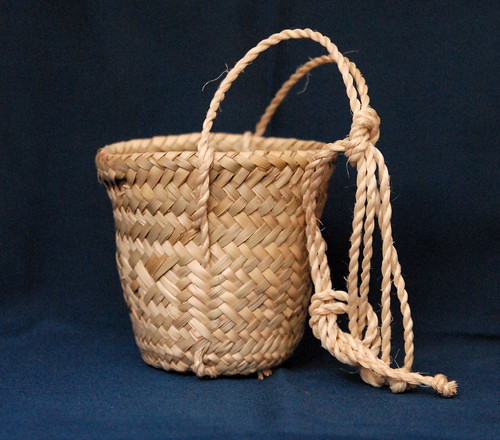 This example of a chiquihuite filled with frijól looks very much like the basket María was using.  I haven't found an Internet or Google result for "taxcal", but that suggests it's just a local usage. Finally, for now, Marías' calling a chiquihuite a taxcal/tenate may just be vernacular, that is to say, imprecise usage. But I would never dare to correct her. |
|











 I had a couple of them years ago,My husband really likes them for dipping bread into.